Planning & Budget
How Much Does a Commercial Gym Cost to Build in New York? A Line-by-Line Budget
What a commercial or building amenity gym actually costs in New York City and Long Island: equipment, flooring, glass, delivery, installation and service, with the ranges I use to budget real projects.
Quick answer
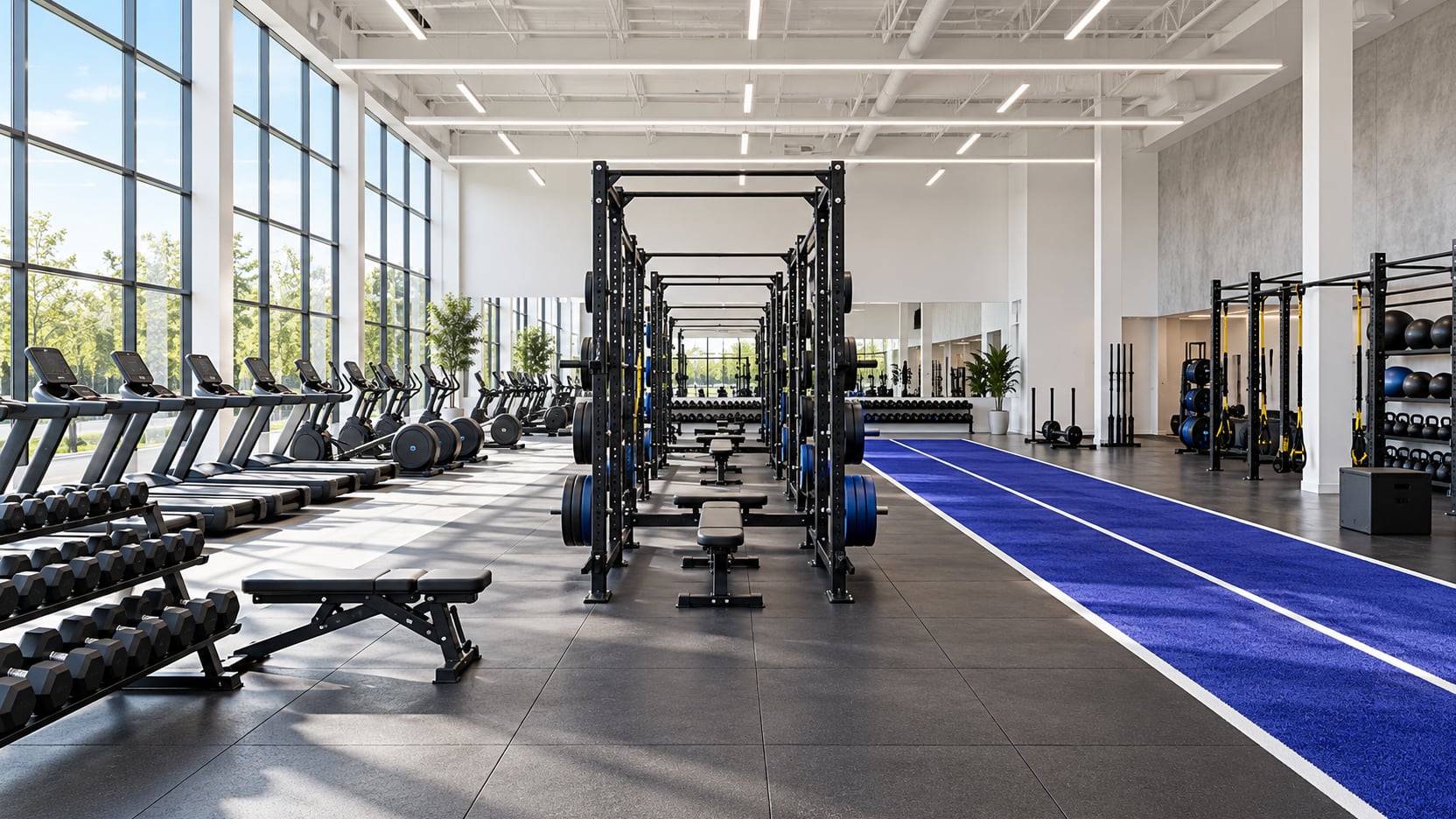
A building amenity gym in New York runs $50,000 to $90,000 for a 500 to 1,000 square foot room, and $120,000 to $250,000 at 1,500 to 3,000 square feet. Equipment is 55 to 70 percent of the total. Flooring, glass, freight, installation and first-year service make up the rest.
Key takeaways
- Budget by the room you have, not by a national per-square-foot average. Ceiling height, floor loading and freight access move the number more than size does.
- Commercial-grade equipment runs roughly $40 to $75 per square foot of gym floor for an amenity gym, and more for a member-based club.
- New York freight, delivery and installation is not a rounding error. Plan 15 to 20 percent of the equipment cost for elevator scheduling, stair carries, assembly and debris removal.
- The 3D layout is the cheapest line on the whole budget and the one that prevents the most expensive mistakes.
- Year-two maintenance should be in the year-one budget. The gyms that look tired at 18 months skipped it.
Every week someone calls me with the same first question: "Roughly, what does a gym cost?" It is the right question and it deserves a real answer, not "it depends." So here is how I actually budget a commercial or amenity fitness space in New York City and Long Island, line by line, with the ranges I use before I have walked the room.
What does a commercial gym cost in New York, all-in?
For a building amenity gym (condo, rental, co-op, corporate office) the number tracks the size of the room closely. A 500 to 1,000 square foot resident gym lands at $50,000 to $90,000. A 1,500 to 3,000 square foot amenity floor or corporate wellness suite lands at $120,000 to $250,000. For a member-based fitness club, where the floor has to survive 6am-to-midnight use and sell memberships on its own, $250,000 to $600,000+ is the honest range at 5,000 to 12,000 square feet.
| Project type | Typical size | All-in budget | What drives it |
|---|---|---|---|
| Condo / rental amenity gym | 500 – 1,000 sq ft | $50,000 – $90,000 | Resident count, cardio-to-strength mix, sound control over units |
| Large amenity or corporate wellness | 1,500 – 3,000 sq ft | $120,000 – $250,000 | Functional zone, more strength stations, glass and mirror walls |
| Boutique studio | 1,000 – 1,500 sq ft | $90,000 – $150,000 | Specialised equipment, flooring build-up, finishes |
| Full-service fitness club | 5,000 – 12,000+ sq ft | $250,000 – $600,000+ | Cardio deck depth, plate-loaded strength, turf, locker adjacencies |
Notice what is not on that table: a single price per square foot. Two 1,000 square foot rooms in the same borough can be $30,000 apart because one has a 9-foot ceiling under the sprinkler line and a freight elevator, and the other has ductwork at 7 feet 10 inches and a stair carry. That is the New York part of this, and it is why I start in the room, not with an equipment catalog.
How much of the budget is equipment?
Equipment is 55 to 70 percent of almost every gym budget I write. For an amenity gym, commercial-grade equipment works out to roughly $40 to $75 per square foot of gym floor. Here is what the individual pieces cost at commercial spec, which is the only spec that survives a building full of residents. The spread inside each line is real: it is the difference between a solid base model and a top-tier console with a screen on it.
| Equipment | Commercial price range | Notes |
|---|---|---|
| Treadmill (commercial) | $3,000 – $15,000 | The most-used and most-abused piece in any building gym. Do not buy residential. |
| Elliptical / cross-trainer | $3,000 – $10,000 | Self-powered models save on electrical work. |
| Upright or recumbent bike | $2,500 – $6,000 | Recumbents matter for older residents and rehab. |
| Stair climber | $7,000 – $12,000 | Needs ceiling height. Measure to the lowest obstruction. |
| Rower | $1,500 – $3,500 | Highest value-per-dollar cardio piece on the floor. |
| Selectorized strength station | $4,000 – $15,000 | Chest press, lat pulldown, leg press and so on. Plan 4 to 10 for an amenity gym. |
| Cable crossover / functional trainer | $4,000 – $10,000 | One piece that replaces four in a small room. |
| Power rack or half rack | $3,000 – $8,000 | Confirm floor loading before you put one over occupied units. |
| Dumbbell set (5–50 lb) with rack | $3,000 – $8,000 | Rubber or urethane. Urethane lasts longer and is quieter. |
| Adjustable benches | $700 – $1,500 each | Buy one more than you think you need. |
A 1,200 square foot amenity gym carrying 6 cardio pieces, 6 strength stations, a functional trainer, a rack, dumbbells to 50 pounds and three benches comes in at $65,000 to $130,000 in equipment alone, before it has moved an inch toward your building.
- Commercial-grade vs. residential-grade
- Commercial-grade equipment is built and warrantied for continuous multi-user operation, typically with heavier frames, larger motors, sealed bearings and a facility warranty. Residential-grade equipment is built for one household and its warranty is usually void the day it goes into a shared space. The price gap is real, and so is the replacement bill at month 18 if you ignore it.
What do flooring, mirrors and glass add?
- Rubber fitness flooring, installed: roughly $7 to $15 per square foot for 8mm to 3/8-inch commercial rolls or tiles. A 1,000 square foot room is $7,000 to $15,000.
- Acoustic underlayment (the thing that stops the unit below hearing a dropped dumbbell): add $3 to $6 per square foot in the free-weight zone. In a residential building this is not optional.
- Turf strip for sled and functional work: $10 to $20 per square foot installed.
- Mirror walls: $25 to $45 per square foot installed, in New York. A 20-foot wall at 8 feet high is roughly $4,000 to $7,200.
- Glass partitions or storefront to separate a studio or the gym from a lounge: $12,000 to $40,000+ depending on size and hardware.
Flooring and glass together usually land between 10 and 20 percent of the total. They are also the items most often value-engineered out by someone who has never had to explain a cracked mirror or a noise complaint to a board. I handle flooring, glass and mirror supply and installation with the same crew on the same schedule as the equipment, which is how the room opens on one date instead of three.
Why is delivery and installation so expensive in New York?
Because the building gets a vote. Budget 15 to 20 percent of the equipment cost for freight, delivery and installation on a New York project. Here is where it goes:
- 1Freight elevator scheduling. Many buildings give you a window, sometimes a weekday between 9 and 4, sometimes with a certificate of insurance requirement and a union operator. Miss it and you pay for the truck twice.
- 2Stair carries. A commercial treadmill weighs 350 to 450 pounds. Walk-ups and half-flights into a cellar gym add crew and time.
- 3Disassembly and reassembly. Some pieces will not fit the freight car in one piece. That work is done by a technician, not a mover.
- 4Protection. Masonite on the lobby floor, corner guards, elevator pads. Buildings require it and it takes labor.
- 5Debris removal. A gym arrives in a lot of cardboard and foam. Somebody has to get it out of the building the same day.
On a $60,000 equipment order that is $9,000 to $12,000. I coordinate delivery, installation and relocation myself, with a crew that has done Manhattan towers and Brooklyn walk-ups, because this line is where most third-party quotes quietly fall apart.
What does gym design and 3D visualization cost?
Less than you would think, and it is the best money on the page. A full facility layout with 3D renderings for an amenity gym is typically $1,500 to $3,000 as a stand-alone service, and on my projects it is credited back against the equipment purchase, so in practice most clients pay nothing extra for it. What it buys you is a board, an owner or a development team approving exactly what will be in the room before a dollar of equipment is ordered. Every six-figure gym mistake I have been called in to fix started with someone approving a 2D floor plan.
What about maintenance after opening?
Equipment breaks. It is not a matter of if. For an amenity gym plan $500 to $2,000 per year for a preventive maintenance agreement (quarterly or bi-annual visits, belt and deck checks, cable inspection, lubrication, console updates), which works out to roughly 2 to 4 percent of the equipment value, plus a small reserve for the occasional repair outside warranty. That is the difference between a gym that still looks new at year five and one residents stop using at year two.
A sample budget: 1,000 sq ft condo amenity gym in Brooklyn
Ranges are useful for reserving money. A real budget is a single set of numbers for a specific room. Here is one I would write for a new-construction amenity room with 9 feet of clear height and freight elevator access, fitted out with four cardio pieces, four selectorized strength stations, a functional trainer, dumbbells to 50 pounds and two benches.
| Line item | Budget |
|---|---|
| Commercial equipment (4 cardio, 4 strength stations, functional trainer, dumbbells + rack, 2 benches) | $48,000 |
| Rubber flooring, 1,000 sq ft installed | $10,000 |
| Acoustic underlayment, 300 sq ft free-weight zone | $1,200 |
| Mirror wall, 20 ft x 8 ft installed | $4,800 |
| Layout & 3D visualization (credited back against equipment) | $0 |
| Freight, elevator, installation, protection, debris (17% of equipment) | $8,200 |
| Accessories (mats, storage, signage, sanitizer stations, timing clock) | $3,500 |
| First-year preventive maintenance agreement | $1,200 |
| Total | $76,900 |
That sits in the middle of the $50,000 to $90,000 band for a room this size. Trade the four selectorized stations for six, put a rack on a reinforced platform and add a turf strip, and you are at the top of the band. Drop to three cardio pieces and skip the mirror wall and you are near the bottom. Which one is right is a conversation about your residents, your competition down the block and your budget, and it takes about 30 minutes.
Where can you save, and where should you never cut?
Save here
- Fewer, better cardio pieces. Most amenity gyms overbuy cardio. Four pieces that get used beat eight that fight for the one outlet.
- Self-powered cardio where the electrical plan is already locked. It avoids new circuits and cords across walkways.
- One functional trainer instead of three single-purpose machines in a room under 1,000 square feet.
- Buying flooring, glass and equipment from one source. One delivery window, one crew, one point of accountability, and better pricing than three vendors each adding margin.
Never cut here
- Commercial grade. Residential equipment in a shared gym is a warranty problem in month one and a replacement bill in month eighteen.
- Acoustic flooring over occupied units. A noise complaint becomes a rule, and a rule can shut down half the equipment you paid for.
- The walkthrough and the 3D layout. Skipping it is how a machine ends up ordered that cannot get up the freight elevator.
- Maintenance. See above.
How do you get a real number for your building?
Send me the room. Dimensions, ceiling height to the lowest obstruction, a photo of the freight elevator door, and who is going to use the space. In a 30-minute call I will tell you what the room can realistically hold, what it will cost within a tight range, and what to sort out with your architect or GC before anything is ordered. It costs nothing, and you keep the answer whether or not we work together. If you are earlier than that and just want to avoid the expensive mistakes, start with the free guide: 7 Costly Fitness Amenity Mistakes.
Straight answers.
01How much does it cost to build a gym in an apartment building in NYC?
For a 500 to 1,000 square foot amenity gym in a New York City apartment or condo building, plan on $50,000 to $90,000 all-in with commercial-grade equipment. Larger rooms of 1,500 to 3,000 square feet with functional zones, glass and mirror walls run $120,000 to $250,000. Equipment is 55 to 70 percent of the total; flooring, glass, freight, installation and first-year service make up the rest.
02What is the average cost per square foot for a commercial gym?
Commercial-grade equipment alone typically works out to $40 to $75 per square foot of gym floor for an amenity gym, and $50 to $100+ per square foot for a member-based club with a deep cardio deck and plate-loaded strength. All-in costs per square foot are less useful in New York because ceiling height, floor loading and freight access change the number more than the size of the room does.
03How much does commercial gym equipment cost?
At commercial specification: treadmills $3,000 to $15,000, ellipticals $3,000 to $10,000, bikes $2,500 to $6,000, selectorized strength stations $4,000 to $15,000 each, functional trainers $4,000 to $10,000, racks $3,000 to $8,000, and a 5 to 50 pound dumbbell set with rack $3,000 to $8,000.
04How much should I budget for gym flooring?
Commercial rubber fitness flooring installed runs about $7 to $15 per square foot in the New York area. Add $3 to $6 per square foot for acoustic underlayment under free-weight areas in residential buildings, and $10 to $20 per square foot for turf.
05Why does gym equipment delivery cost more in New York City?
Freight elevator windows, certificate of insurance requirements, union buildings, stair carries into cellar or walk-up spaces, disassembly to fit elevator cars, building protection and same-day debris removal all add crew time. Budget 15 to 20 percent of the equipment cost for New York freight, delivery and installation.
06Is gym design and 3D visualization worth paying for?
Yes. A full layout with 3D renderings is typically $1,500 to $3,000 stand-alone and is credited back against the equipment purchase on my projects. It lets a board or owner approve exactly what will be in the room before anything is ordered, which is what prevents the expensive mistakes: equipment that does not fit the elevator, racks under ductwork, or cardio with no power.
07How much does gym maintenance cost per year?
Plan $500 to $2,000 per year for a typical amenity gym, roughly 2 to 4 percent of the equipment value, for a preventive maintenance agreement plus a small reserve for repairs outside warranty.

Written by
Ed Perez
Founder, Gyms By Ed · Former gym owner & master trainer · 30+ years
30+ years in the fitness industry: owner of three gyms, coach and trainer, and commercial gym designer and equipment consultant with 500+ projects delivered across New York City, Long Island and the tri-state. Every number here comes from projects I have budgeted, sold and stood on site for.
Have a room and a question?
Send me the room. Thirty minutes, free, and you leave knowing what your space can hold and roughly what it costs.
Keep reading
- Commercial gym design in New YorkThe six things that sink New York gym builds, and how the work runs from walkthrough to opening day.
- Free guide: 7 Costly Fitness Amenity MistakesFor developers and property managers, before you spec anything.
- Everything I supply and installDesign, equipment, flooring, glass, delivery, installation, maintenance. One source.